








Forgot your password?
Member benefits:
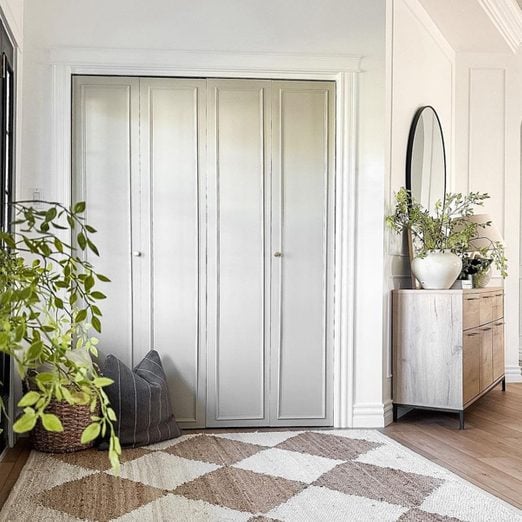
Less than 15 3/4" wide and 6 1/2 feet high this shelved cupboard has two doors and a foldaway ironing board.
Step 1: Mark the Shelf Positions
Step 2: Finish the Shelf Holes
Step 3: Assemble the Cabinet
Step 4: Hang the Doors
Step 5: Make the Ironing Board
Step 6: Attach the Stopper
Step 7: Add Melamine Edging
Step 8: Attach Fabric to the Board
On a side panel mark 3 3/4", 15", 26", 37 3/4" and 64" from the base, using a melamine offcut to mark the 5/8" thick shelves. Position the sides together to drill pilot holes with a 1/10" combination bit, going through the first panel to mark the second one.
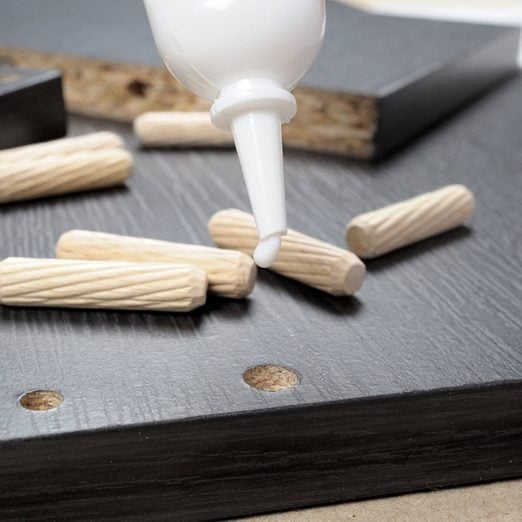
Position the side panels next to each other to extend the shelf lines, drilling and countersinking the holes. On the base, position the plinth 1 1/4" from the front, drilling pilot holes and countersinking to secure with screws.
On a side panel secure the top and base, attach the top shelf flush with the back, middle shelf flush with the front and lower shelves 1 1/2" from the front, then attach the other side. Secure the backing with panel pins spaced 7 7/8" apart.
Temporarily position the hinge cups to mark the screws, using a 1/4" bit to drill 3/8" holes. Tap in the hinge cup plugs then reposition the hinges, securing with screws. Align the baseplates and secure with screws then hang the doors and add handles.
Measure 23 3/4" from the base of the board, tapering the other end to 5" wide according to the template and cut with a jigsaw, rounding the edges with 150-grit abrasive paper. Position the foam, using a staple gun to secure it underneath.
Underneath the ironing board measure 15 3/4" from the base to secure a 2 1/2" x 2 1/2" x 3/4" wood offcut, adding two 2" x 1/2" dowels spaced 3/4" apart. Attach butt hinges to the base then secure them 2" from the front of the middle shelf.
Iron-on edging is used to neatly finish the edges of timber-based products like MDF, particleboard and plywood. It comes in a range of veneer finishes and colors and is backed with an adhesive that bonds to the surface when heated with an iron.
To bond the edging strip, set the iron to high with the steam off then cut the edging to length with 1/2" extra at the ends, positioning it to overlap the sides equally. Cover with baking paper and run an iron along it using short to-and-fro motions.
Apply pressure along the strip using a small roller until the adhesive cools then trim along the sides with a fine square-edged file, working downwards and holding it at 20°, finishing by smoothing the edges slightly with 180-grit abrasive paper.
Staple on your fabric of choice to the board, securing with a staple gun. Trim away excess fabric.
Get fresh ideas in your inbox with the Fresh Home Newsletter!
Sign Up »