









Forgot your password?
Member benefits:
Moroccan Origins
Step 1: Prepare the Base
Step 2: Prepare the Top
Step 3: Make the Arch Template
Step 4: Cut the Arches
Step 5: Mark Up the Cutouts
Step 6: Make the Cutouts
Step 7: Complete the Tabletop
Step 8: Assemble the Base
Step 9: Attach the Tabletop
Produced by Darryl Chapman
This style of colorful furniture is found in traditional Moroccan houses called riads, from the Arabic word meaning garden. Closed to the outside, a riad is built several stories high around an open-air garden with a water fountain and citrus trees. Adapted from Roman villa designs and decorated by Spanish artisans, they faced inward for hot summers and cold winters, with decorative tiles for insulation. They became popular restoration projects in the 1970s and are now commonly converted into boutique guesthouses.
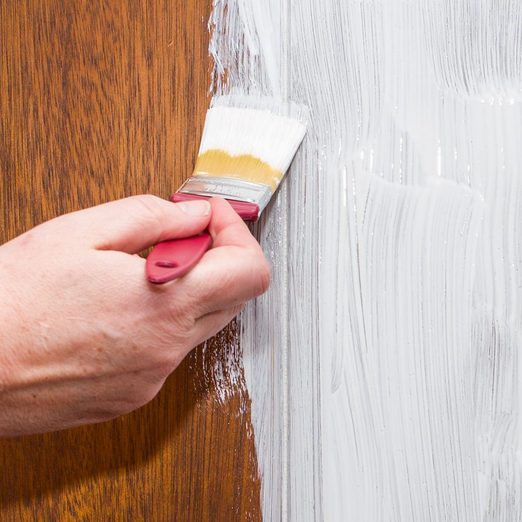
Prime the base panels, lightly sand with 180-grit sandpaper, then apply two coats of colored acrylic (we used teal blue) on the inside faces, avoiding paint build-up on the beveled edges.
Position the top pieces side by side, applying wood glue to the adjoining edges, securing with long clamps at the side and small clamps to keep the top flat, leaving until dry.
Transfer the arch onto cardboard, using the base of a small can of wood putty and a 25-cent coin to draw the curves. Cut out the shape, making a hole at the drill point 3/4-in. from the top. Transfer the arch onto the base panels.
Using a 1 1/2-in. hole saw, cut out the top of the arch, starting at the drill point. Use a jigsaw to finish making the arch, then smooth the edges with a drill and sanding drum. Prime then paint the edges and leave to dry.
On each base panel, 4 3/4-in. from the top, draw a line across the center-line. Set a compass to 5/8-in. to mark a 1 1/4-in. circle from the center. Position the compass on the intersecting points to mark up four circles.
Using a 1/4-in. brad point drill bit, make a starter hole at the center of the circles. Fit a 1 1/4-in. hole saw to the drill to make the circles, drilling until the pilot bit starts to break through, turn the panel over to finish the holes from the other side.
From the center, mark eight 7 5/8-in. lines 45° apart and connect the ends to cut the octagon with a circular saw. Cut the molding with ends at 22.5°, position the pieces around the top, securing with wood glue and tape until dry.
Position the base panels, unpainted faces up, to join the edges with masking tape. On the other side, apply glue to the beveled edges then roll into an octagon, securing with tape until dry. Sand the base and top with 180-grit sandpaper.
On each cleat, drill two 1/4-in. countersunk holes through one side and a hole through the perpendicular side, use two #8 x 1 1/4-in. countersunk screws to attach cleats to the inside of the base. Position the tabletop, securing up through the cleats.