






closeX
Log In
  1. Remember me on this computer

Forgot your password?

NOT A MEMBER YET?
Join us (it’s free!) and you’ll get instant access to our friendly community of decorators and DIYers like you.

Member benefits:

  • Comment on projects and slideshows
  • Sign up for free DIY newsletters
  • Coming soon: Save and organize your favorite projects
  • And more!
Join Us Today

Step 1: Build the Two Outer Frames

Clamp the four outer frame stiles (the long vertical pieces) together with the face edges up. Make sure the ends are flush. Mark out the rail positions (see diagram below). Square the lines across all four edges. Mark the rail positions with a large "X" to avoid confusion.

Finished DividerChris L. Jones[+]
Diagram of Two Outer Frames[+]

TIP

We designed this project to minimize waste and work. You can cut two 2 3/4-in. legs (stiles) from a 1x6 (which actually measures 5 1/2-in. in width) and two 1 3/4-in. rail pieces from a 1x4 (which measures 3 1/2-in. in width).

Step 2: Mark the Rails, Test Fit the Pieces

Clamp eight rails (the horizontal pieces) together and mark the center position of the short 1 3/4-in. mullions that run down the center of each screen. Mark both edges of the rails. Make sure all the pieces are flat on the bench during the marking process. Set all of the pieces of each screen on a flat surface in the exact position they'll be when the frame is finished. Lightly number the members of each joint.

TIP

We built our screen 52-in. tall—but, you can easily modify our plan to create a taller version. And if you do, you'll wind up with even more space for displaying your favorite photos.

Step 3: Mark the Dowel Positions

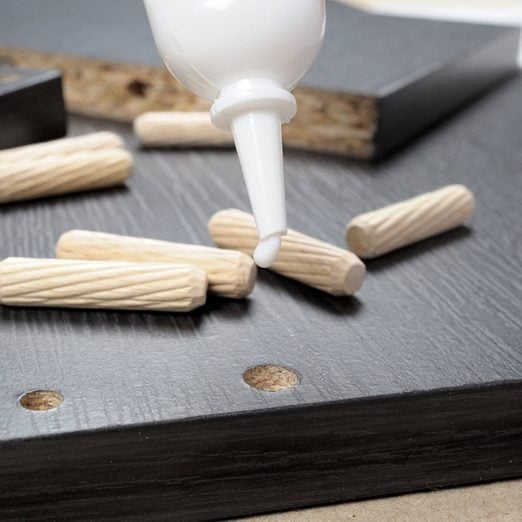
Make pairs of short lines across each joint to indicate the position of each pair of dowels. Label all the joints and their exact position before marking the dowel positions. Mark the rails and mullions so each dowel is positioned 3/8-in. in from the edge. Drill 7/8-in.-deep holes using your jig and brad point bit. Keep your drill bit perfectly square to the face of the board as you drill.

TIP

Consider purchasing and using a "biscuit joiner." This clever tool cuts slots into each member, then uses a single football shaped biscuit, instead of two dowels, to make the connection. It's faster to use and gives you more "wiggle room" during assembly.

Step 4: Assemble the Rails and Mullions

Set the vertical stiles aside. Apply glue to the dowels, dowel holes, rails and mullions, then tap the pieces together so all eight rails and seven mullions are joined to one another. Use a long bar clamp to snug the pieces tightly to one another, then let the assembly dry for one hour.

TIP

Sand all the edges of the pieces to be joined before gluing up the screen.

Step 5: Install the Stiles

Apply glue to the dowels and ends of the rails, then carefully position the long stiles on each side. Use several clamps to snug everything together. Set each completed frame aside so the glue can dry overnight.

TIP

Go light on the glue. The more that squeezes out, the more you'll need to clean off. Any glue that remains will make the stained area look blotchy. Also, each screen takes several minutes to assemble once all the pieces are cut, marked and ready to go. Be prepared so your glue doesn't set up during assembly.

Step 6: Build the Center Frame

Build the center frame using the same steps used to build the outer frames.

Diagram of Center Frame[+]

Step 7: Taper the Stiles

Mark the tapered bottoms of the stiles. Measure 10 in. up from the bottom and 1 3/4-in. in from each outer edge. Connect these marks, then use a circular saw or jigsaw to cut the taper. Smooth your cut using a belt sander.

Step 8: Sand the Frames

Use a finish sander or random orbital sander to smooth both sides of all three frames. Remove any pencil marks or glue at the same time. Start with 80-grit paper and finish up using 150-grit paper

Step 9: Stain and Apply Finish

Apply stain to the edges and one face of each frame, let it dry, then flip it over and apply stain to the other side. Once the stain has dried (read the directions on the label) apply a clear finish of your choice.

Step 10: Attach the Hinges

Attach two 1 1/2-in. brass butt hinges to the adjoining frames. The hinges should be arranged in opposite directions to allow folding.

Finishing Touches

If the screen will be used for photos, use a router and 3/8-in. rabbeting bit to cut insets on the back of each opening. Secure each photo in place using 1/8-in.-thick plywood for backing and picture framing tape.

Finished Divider 2Chris L. Jones[+]
closeX

Add a Comment For:

How to Make a Double-Duty Divider

Here’s what I think:
closeX

Add a Reply For:

How to Make a Double-Duty Divider

Here’s what I think:

You Might Also Like

More
Hello Stranger!   Log in or Join us
Advertise with us Advertisement
Family Handyman