






Forgot your password?
Member benefits:
This self-taught dynamo is out to prove that anyone can build furniture.
Before You Start
Step 1: Drill Pocket Holes
Step 2: Add Locker Dividers
Step 3: Attach the Back
Step 4: Build the Face Frame
Step 5: Attach the Crown
Step 6: Fill Holes with Plugs or Wood Filler
Project by Ana WhiteWritten by Heather Lamb
Overall Dimensions are shown below. The composition is solid wood pine boards. Distress away! Ana has this cabinet sitting in her entryway and it is quite large. She chose to keep the width at 48" to minimize wasted plywood on the back.
Drill these with the pocket hole jig on the underside of both ends of all the shelves and the top edges of the sides. Starting at the bottom of the side boards, measure and mark three spots for the placement of the shelves. Measure 4 3/4 in., then leave a 3/4-in. gap for a shelf, measure 10 1/2 in., leave another gap, and measure 36 1/2 in. Use glue and 1 1/4-in. pocket hole screws to attach the top to the sides, using a square for accurate right angles. Attach the shelves to the sides using the same method.
Drill pocket holes on the tops and bottoms of the locker sides. Place the middle shelves 15 in. from the side boards. With glue and 1 1/4-in. pocket hole screws, attach the locker sides to the shelves.
With the cabinet lying face down, apply glue to the back edges of the shelves and sides. Carefully lay the plywood, paneling or MDF on top, and nail down with 1-in. nails. Nail to all sides, shelves, top and the locker sides.
Drill pocket holes (two per end) on both ends of the footer trim and the top ends of the side trim. Mark the side trim 3 in. from the bottom and attach the footer through the pocket holes to the side trim. Attach the header trim to the side trim through the pocket holes. Use the 2-in. finish nails to attach the face frame to the front of the cabinet, keeping all outside edges flush and level with the bottom of the cabinet. Use glue.
Tack it to the face frame with 2-in. finish nails and glue. It will create a flat surface with the top and jut out slightly from the face frame.
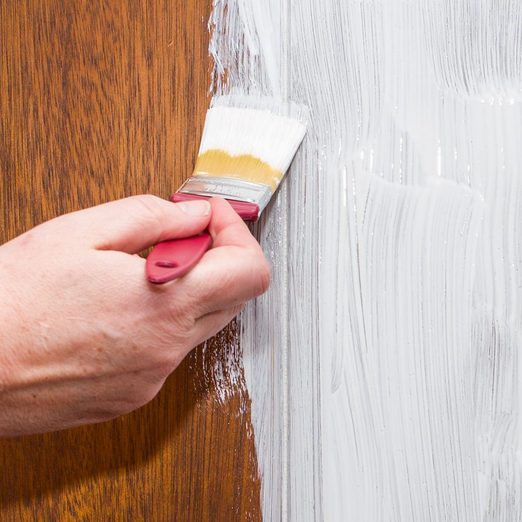
Let dry completely. Sand the entire cabinet with sandpaper and vacuum up sanding residue. Wipe with a damp cloth to remove any remaining sanding residue. Apply a water-based interior primer. Lightly sand with a brown paper bag. Follow with paint, brushing in the direction of the wood grain. Attach hooks to the sides of the locker cubbies.